Connecting mental health practitioners to improve multidisciplinary mental health care in Australia.
MHPN’s interactive webinars feature case-based discussions and Q&A sessions led by top experts, modeling multidisciplinary practice and collaborative care.
Mental Health in Practice is a podcast for health professionals working across the mental health system, featuring conversations grounded in real-world experience. Each episode brings together perspectives from clinical practice, research, and sector expertise to explore contemporary mental health care.
Extend your knowledge and explore the following curated collections of webinars, podcasts and networks, highlighting selected topics of interest.

Connecting mental health practitioners to improve multidisciplinary mental health care in Australia.
Mental Health in Practice is a podcast for health professionals working across the mental health system, featuring conversations grounded in real-world experience. Each episode brings together perspectives from clinical practice, research, and sector expertise to explore contemporary mental health care.
MHPN’s interactive webinars feature case-based discussions and Q&A sessions led by top experts, modeling multidisciplinary practice and collaborative care.
Extend your knowledge and explore the following curated collections of webinars, podcasts and networks, highlighting selected topics of interest.

Vicki Ryall (00:00:12):
Good evening, everyone. Thank you so much for joining us. We’re very excited to be here talking to you about the Headspace Good Care Framework. I’m going to introduce my delightful colleagues very shortly, but I will start by acknowledging this evening I’m coming to you from the lands of the Wurundjeri Woi Wurrung people of the Kulin Nation. I want to pay my deepest respects to the elders of these lands and the lands that you’re all on right across this country. Feel very lucky to live and work on these lands and pay respect to the longest continuing culture in the world. I have a few of my First Nations colleagues with me tonight, so I want to honour them and their elders and the elders also acknowledge any other Aboriginal Torres Strait Islander people here that I can’t see. Thank you so much for having us. We’re here to talk about a piece of work we’ve been doing for nearly two years that we’re calling the Headspace Good Care Framework.
(00:01:20):
It’s a very simple title. It’s actually been quite a challenge. Our goal was to, what we’re trying to do tonight is talk to you about the purpose of the framework, which really is to articulate what good care is for young people and families that is called Headspace Good Care Framework because we’ve come up with it, but we think it’s useful for anyone practising with young people inside and outside the Headspace Network. And what we’re going to do is talk to you about how all of the elements of good care come together to serve this purpose. So we’re going to go through some foundational elements of it and then talk through what you’ll see are the petals. So I’m going to introduce my wonderful colleagues, Nicola Palfrey, who’s the head of clinical practise, Ruby Warbur, who’s our First Nations Mental Health and Wellbeing lead. Tyler Kennedy, who’s a member of our First Nations Youth Advisory Council and Layla Palmer, who’s also a member of our First Nations Youth Advisory Council.
(00:02:38):
I wonder, team, if you might tell the audience your favourite season and why. I’m going to start with you, Nicola.
Nicola Palfrey (00:02:56):
Thanks, Vicki. And hello, everyone. Nicola Palfrey. I us she/her pronouns and I’m joining you from Ngunnawal Country this evening. It’s officially winter here, which is not my favourite season. I don’t mind winter, but my favourite season, I like that I have seasons in the places I live, but on Ngunnawal Country Autumn is my favourite season because it’s clear and it’s cool at the evening, but it’s beautiful during the day and the changing of the leaves and the kind of beauty that is autumnal colour is my favourite. So yeah, that’s my favourite season. Thanks, Vicki. Do you want me to throw to someone? I might throw to Ruby.
Ruby Warber (00:03:37):
Yeah, thanks everyone. I’m Ruby Warbur. I’m a Noongar, Western Australia, so I’m going to say my favourite season is summer because I love the heat and I also love gardening. So if it was summer right now, I’m joining you from cold and wet Wurundjeri country, but 7:00 PM in summer, I’d be out in my garden still, so I’ve got to say summer is my favourite and I’ll hand over to Tyler.
Ty Kennedy (00:04:04):
Yeah. Following on from you, Ruby, I’m definitely a summer person. Most definitely the late summer nights You can’t really do that here in winter. You’ll get chased inside by the cold winds, so definitely a big fan of summer. I might have to pass it over to Lei.
Lei Laupama (00:04:24):
Hi, everyone. I’m Lay. I would say that my favourite season is probably like Nicola is autumn. I like the cooler nights, seeing the stars and just being a bit frosty in the morning. I don’t know why, but it’s something I love.
Vicki Ryall (00:04:45):
Thank you very much, everyone. I am also a summer person. Often wondered why I’ve not moved further north or somewhere warmer generally, but I also appreciate the beauty of autumn and spring. Now we are going to go through the Good Care Framework in turn in conversation with my colleagues. I’m going to let you know a little bit about how we got here. We have a really large network, 175 services across this beautiful country, and it’s a national model with a locally responsive implementation, but we’d also like young people and family to have an experience that is somewhat consistent. And we were rolling out different training and resources to support the network around, say, family inclusion or responding to alcohol and other drug issues. And what we found is that there was a loss of a view of the rest of practise when we were talking about one thing or trauma-informed training people have been very keen to do, but when we were looking at trauma-informed, there was an absence of family inclusion and cultural responsiveness, for example.
(00:06:11):
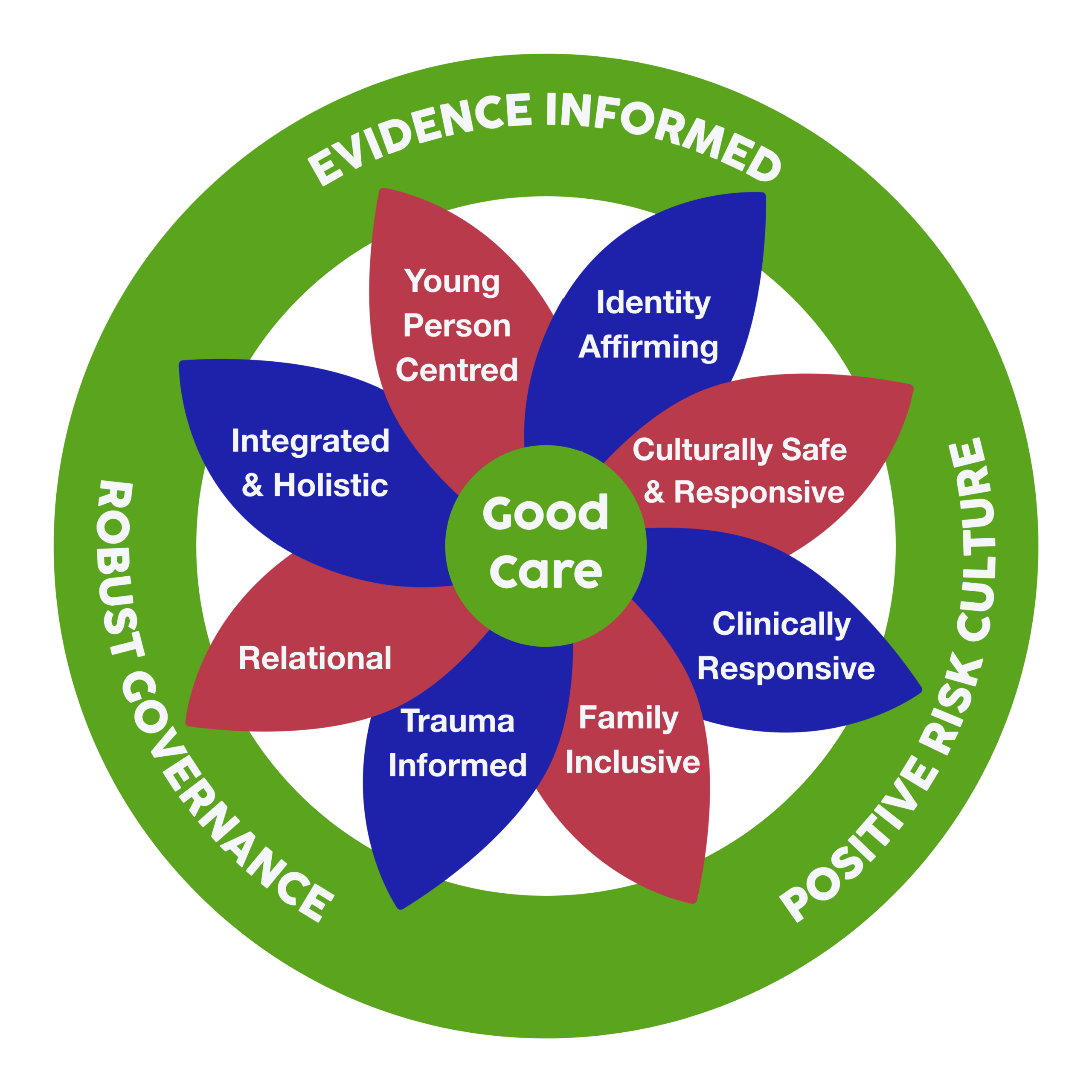
So we developed this to bring everything together. And once we developed the diagram, if you can put that on the screen now, that would be wonderful. Thank you. We realised that the best quality of care is where all of these pedals overlap in the middle and that they’re supported by the foundations which go around the outside, which Nicola will speak to shortly. And we think that this is useful for individual clinicians to think about their practise and look at where you may want to develop some more than others for a team to think about strengths and weaknesses for I might want to develop on a journey to improve my cultural knowledge so that I can move further along the cultural responsiveness. So reflective tool, a useful team tool, and just a nice reminder that you can hold in mind relatively easily. So I might hand to Nicola now to go through the foundations.
(00:07:21):
Thank you.
Nicola Palfrey (00:07:23):
Thanks, Vicki. Hi, everybody. Yeah, I’m going to take you through in the visual that you can see the pedals are very pretty and they all come together for the centre of good care. But when we were developing this model, we had various iterations, but we ended up with this visual to think about the whole becoming bigger than the sum of its parts, but also what we needed grounded that grounds all of this work. And so we’ll go through them. I won’t take up too much time because I’m much more interested in hearing from the other panellists about what this looks like in practise, but I’ll go through the three foundational components to start off with. So if you can go to the next slide, governance, it’s not probably everybody’s favourite topic, but it’s really important. And I think the robust governance foundation speaks to how you provide safe and quality care for all young people.
(00:08:16):
And you can see that it often gets thought about as being held perhaps in higher ups or in quality systems or in documentation, but it’s actually about how it comes into life for young people and family and communities experience that we are really interested in. And it’s supported by governance systems that’s supported by quality improvement. It’s supported by transparent and clear processes. But the other thing that we were really keen to think about is how the different types of governance come together and this is a journey for all organisations. But if we go to the next slide, one of the key things of the Good Care Framework is thinking about the kind of operational governance or organisational governance overall, that these three things need to come together. So there’s clinical governance, which a lot of you will be familiar with, particularly those of you working in those clinical settings and roles around risk and management and escalation and who says what, to whom, when and how that all works.
(00:09:12):
But also corporate governance is again, something that probably operational leaders are more familiar with in terms of the boards and the accountability and reporting and so forth. And the advent and addition, I suppose, more recently and recognition of the real importance of cultural governance that needs to be in place in order for us to provide good care is something that we are really keen to emphasise and to align alongside governance overall. So ensuring that the wisdom and knowledge and governance of how we work with people from all cultural backgrounds is integrated in and alongside and not against, not versus, but alongside the other types of governance is something that’s really important for this framework and for the work. And it is a journey like in headspace services, a number of services but not a lot necessarily yet have cultural governance frameworks, for example. And so there’s a lot of work being done by the teams that Ruby and the team here are engaged with about how services can develop cultural governance frameworks to bring this to life in practise every day for the people that we serve.
(00:10:21):
So next slide, please. Evidence informed seems obvious, but everything that we do in terms of providing the good youth mental healthcare needs to be grounded in evidence. But again, looking at what we mean by evidence, obviously scientific evidence and randomised controlled trials are important and an important component of what we do every day, but there’s so many forms of wisdom that come together in terms of how you provide evidence-informed care. That’s the incorporation of lived and living experience and the wisdom that they bring to not just how a centre looks and feels, but how the experience is and how the care is delivered for young people and families so it meets their needs. And at Headspace, we’re really committed to that throughout all levels of care that we provide and all of the governance that we provide as well. Also the wisdom of practitioners. So a lot of us know that you have a lot of knowledge based on the work that you do that may not be written up in a way that is published in scientific journals, but there’s a lot of wisdom from all of what we do and what we know about the communities we serve that needs to come into it, the preferences and wisdom of our First Nations cultures and also the cultures of the many and varied multicultural people that we’re blessed to live and work alongside and how adapting that our practises to meet that are part of the evidence informed.
(00:11:48):
And then also all of the structures and systems around supervision, reflective practise, case review, bringing together the multidisciplinary teams that are necessary to provide the best care. It’s not just about clinicians providing mental health treatment intervention. It’s about all of the different lenses that make up a true multidisciplinary team to make sure that young people are getting the needs that they need addressed in a timely fashion. And then the final component of it, or one of the other components of it is around measurement-based care and learning health systems. So using outcome measures and we ask a lot of young people when they come to our services to tell us how they’re going to rate themselves on K-10s or other measures, how do we use that information to inform their care to track their progress, to share their wins, because it’s not easy to see. All of you would know that when you’re working with young people, often they’re not the best measure necessarily of how well they’re doing.
(00:12:47):
And we can see that in progress over time. None of us are necessarily always across how we are developing new skills or managing things in different ways and using the learnings that we develop through the network that we have to drive information and learning to the sector more broadly, which is part of why we’re doing what we’re doing tonight. Next slide, please. The final component or foundational element of the good care model is positive risk culture. And this is a concept which was quite hard to develop and articulate. It’s an accumulation of, I suppose, insights and learnings and desires from all of the work that we do to think about how we best serve young people and family. And it’s not a well articulated concept in the youth mental health sector or the mental health sector more broadly. It’s much broader than thinking about management of risk to self or other, which is what can happen.
(00:13:47):
When we talk about risk, it often gets reduced and narrowed to how do we manage young people presenting with acute risk, for example. Positive risk culture is about a recognition that risk is inevitable and natural. Certainly working with young people, 12 to 25 risk is a kind of beautiful part of life and a frightening part of life. If there wasn’t risk taking in young people, we wouldn’t have the innovations that we have in life today and also that risk is frightening for people, whether it be risk of young people experiencing thoughts of harm to themselves for example, but it is a natural and common. So one in four young people that present to Headspace Services present with thoughts of suicidality. And so risk is inevitable and shared. And so risk positive culture acknowledges that, understands and recognise that risk management in all its forms is a shared responsibility.
(00:14:45):
So clinicians have responsibility, but it’s never shared alone. It’s shared with the team, with a young person, with their care network and we need to have open and transparent conversations around management of risk, the dignity of risk as well and also risk averse practises that we can fall into, which is again, a very natural response to high demand, long wait lists, et cetera. We can get narrower and try to engage in practises that we think are helpful, which is we’re not the right service or how do we screen people out or put them into other services or do lots and lots of assessment to eliminate risk. It’s not possible. So risk positive culture really tries to open up the conversation about how do we live with, embrace and manage risk in a collective and positive way that keeps everybody feeling safe, supported and clear about what we need to do to provide care that is equitable, that is available and is flexible and meets the young people’s needs that are trusting us when they come forward to share their selves and sometimes their most vulnerable states.
(00:16:01):
I think that’s it. And next slide, please. I think the one more slide that just kind of elaborates what I was talking on. So when there’s a positive risk culture, it has that healthy and balanced approach to risk. We recognise the disproportionate impacts of risk adverse practises on particular young people and family and communities that seek our help. So First Nations, multicultural young people, as well as LGBTQI+ young people that face additional barriers, not just to care, but to being well due to discrimination and practises that happen out in community that they are subject to just by being who they are, not being themselves is not the risk profile, it’s the treatment that they receive from others or the isolation and discrimination that they receive. And that risk, as I said, is inevitable and part of what makes young people who they are. So a risk positive culture acknowledges that and helps everybody feel held and able to know how we manage risk in a calm, collective and positive way, I suppose.
(00:17:10):
So I think that’s probably enough for me about the foundations and I will throw back to you, Vicki, I think that’s the end of our – Thank
Vicki Ryall (00:17:16):
You. There’s one more slide that we can put up while I’m about to go to lay next. But I guess this is just one final comment on positive risk culture, because when we’ve had conversations with clinical leads and managers and clinicians at all levels, it has been one of the things that people have had the most questions about. So certainly feel free to put questions to us about that. But I think it is useful as a framer for yourself if you have worries and you are trying to manage for yourself and your own individual practise or you’re a clinical leader of any description, what is the risk and how might I seek to address that and what is the most compassionate thing I can do for the young people and family? And hopefully that’s a tension and we fully acknowledge that, but Positive Risk Culture asks us to balance that tension with care and compassion primarily, which is easier said than done.
(00:18:28):
Now we’re going to talk through the pedals. So I wonder if we can go back to the original diagram of the model please. Thank you. And Lei is going to talk to us about their experience and describe briefly identity affirming culturally safe and clinically responsive. And there might be a mention of evidence informed with the measurement-based care aspect of that. Over to you, Lei.
Lei Laupama (00:19:02):
Hello, everyone. So I’ll be talking about identity-affirming care first. So from a lived experience/surveying experience of being with Headspace and having them use the good care framework, the identity-affirming has been not just seeing one part of myself, but seeing me as a whole holistically and that had to do with everything from gender, the cultural identity, faith, neurotype, and sexuality. And mind you, I make up majority of those. So it’s kind of nice to know that I’m being looked after fully and wholly. And how the Good Care Framework works with it is it shows the intersecting aspects of identity within a person. So it’s not just about your mental health or about your physical health, it’s so many more things that make you a whole as a person. So it’s very identity-based. And I mean, clinicians that I’ve worked with and also talked to as well have all worked with me in a really collaborative way to make sure that I’m being understood, that they’re coming from a curious and open-minded manner.
(00:20:20):
So it’s always being taught by your young person on who they are instead of coming with what you think they might be because of different labels or different intersexing things. You can have your own education on things too. I love that and I love that people are educated on those things. It’s just not coming with a certain perspective on those things, being open-minded and making sure that your young person is the one guiding you and following you in their own identity, because it is a person-based, person-centered role. Not only that, but the identity affirming, it was really affirming in the sense of I’m First Nations, I’m non-binary, so I’m gender diverse, I’m pansexual, or as I like to say, queer, and I’m neurodivergent as well. So the impacts of all these things, not only individually, but together of discrimination and marginalisation and stigma is very big.
(00:21:30):
And it was really great to see my own clinicians and multiple clinicians that I’ve seen actually work within and go, “This is not okay in acknowledging why parts are intersecting or why parts are, ” and trying to intertwine them to teach me how to deal with it on a better way or maintain it. And it is such a big celebration as well, identity-affirming care because it’s showing the strengths and connections that I have with my identities and celebrating all of them. So it’s not just pulling them apart and seeing them for what they are, it’s celebrating exactly what they are too. It’s celebrating the individuality of each section, but also how they all come together and connect as well. So it’s lovely. And my next thing I’ll be talking about is culturally safe and responsive care.
(00:22:35):
As I’ve talked about, I am First Nations and I’m going to speak more so from a First Nations point of view on this, but the culturally safe and responsive care is I’ve been shown that I don’t have to educate consistently on my own identity as a First Nations person or my cultural background and stuff. It’s when you put the onus on a young person to educate you on something like that, it can be a colonial burden on that kind of thing. So you don’t understand where this young person is at with, they could be in stolen generations. So asking them questions about their mob or about culture itself can be very triggering and you can retraumatize a person from doing that. So doing your own research and coming to your client with questions, just like open-ended questions, not really… Because in a sense, if you’re asking very specific things culture-based, it can be if I don’t know that answer as a young person, I’d be like, oh, I’m not Black enough, or I’m not Polynesian enough, or I’m not wide enough because I don’t know those information.
(00:23:50):
So it’s kind of like having to come from a space of tentative asking sometimes on things like that, because it can be hard to ask, but I’d rather you get it wrong and us work together through it and go, “Hey, I didn’t really like the way you phrased that, but I can understand that from your point of view, you were trying to ask me these things to understand. Maybe we can go from somewhere else because you’re going to get it wrong. If you’re not the culture or you’re not within the culture, you’re not going to fully understand and that is okay. You’re allowed not to understand. I mean, we all come from different backgrounds, we’re all diverse, so it’s okay to get it wrong and then we can work together collectively and collaboratively in your therapeutic sessions or without and work through it. And I mean, the staff have been so committed to recognising and addressing responding to racism in all forms of discrimination as well.
(00:24:57):
So anything a young person can take as maybe being racist or discriminatory is something that you should take very, very seriously. Even if you don’t fully understand why it would be so impactful or anything like that, I know that Headspace as a whole is very big on the, we’ve got this, you can do the complaints, we’ll put them up to here and everything like that. It’s really good. And they’re working within their own systems as well to break down that stigma and that discriminatory language that even big companies like Headspace don’t even know they’re getting wrong too. So it’s working collaboratively with your young person and going, Hey, what do we need to know from you as well to be like, I’m not fully informed in this, you can help me out and I’m helping you out. It’s kind of a give and take. And there’s always, always a huge thing on making sure the communities, not just First Nations communities, but multicultural communities are being respected and brought in to the centres or into Headspace National as a big hole to properly get everyone’s perspectives, not trying to put an agenda on it or put our own little bias or systematic biases into it.
(00:26:29):
It’s just we get it from the people who we want to get it from because that’s the people we care about and that’s where the person centred comes from. And then my last one I’m going to quickly talk about is clinically responsive care. So I’m looking at this from a measurement-based approach, a message-based care. So you talk about your K-10s, we’ve got Headspace talking about MyLife tracker and things like that. So I think Headspace, one, does a great way of doing measurement-based care, but not only that, it is so important to do, not only for the fact of having your data collection and knowing where a young person has been and where they are going, but also in that reflective practise of coming back to your client and going, “Hey, do you see where you were from at this point at the beginning till the middle till almost the end?
(00:27:25):
Do you know what’s happened during that time?” So reflective practises is so good in measurement-based care to help formulate processes that can guide your clinical judgement and help your young person’s needs and the family circumstance and support so many of your evidence-based care planning.
(00:27:49):
I’ve said this before the people and I mean, you have to be transparent and open with your clients when you are asking for their data. So it’s why are we getting this data? Why is it useful and what do you think we can do with this data? So it’s not just, “Hey, you have to do this K-10, this is just a part of what you’re doing and we’ll just write it all down, explain it to your clients, be like, this is why we do this, this is why the K10 is a thing, this is why the MyLife tracker is a thing.” And then when you bring it back into your client sessions as well for a young person, it helps to fill out their entire therapeutic journey with you, not just in the sense of, “Hey, you did good here, celebrate this small wins.” It’s like, do you remember this big thing was happening in your life and this is how we’ve maintained it and this is what’s showing up in the data saying that, “Hey, look, you’ve actually been doing well in these bits, these things you are having problems with, but hey, it keeps moving and it’s celebrating those wins.” So it’s being consistent with coming back with your evidence-based care and going, “Hey, this works.
(00:29:13):
Do you want to know why this works or why do you think this worked?” And oh, this type of modality or therapeutic way of helping really, really helps. So I mean, yeah, it’s definitely something to be used. It shows in the data not only through Headspace, but just in general through the health system that these data things work. You use them, they work, they’re great.
Vicki Ryall (00:29:45):
Thank you so much, Lei. That was beautiful. My Life Tracker is a Headspace young person rated measure not dissimilar to the Session rating scale or outcome rating scales, but with a couple of additions of I felt my culture was respected, we’ve published a paper on that. If you want to, we can share that through MHPN after this is definitely worth having a look at. It’s been validated with young people. Tyler, you are going to also talk a bit about culturally safe care, but also about young person-centered and integrated and holistic. So over to you.
Ty Kennedy (00:30:31):
Beautiful. Thank you very much for that, Vicki. Yeah, speaking about cultural safety, it’s hard to follow on from Lay. They did such a lovely job. Yeah, so where to begin? Speaking from my lived experience engaging with Headspace services, both as a young man through high school and then onto university, I did feel like Headspace amongst other mental health providers was definitely one of the more competent when it came to cultural safety. I’ve had some lessons sell performances from independent mental health services, so Headspace really does lead the way in that regard. Apologies. I’m a bit stumped. There’s so much to talk about. I feel like throughout the creation of this framework and speaking to Lay throughout this process, I feel like cultural safety has been a big, big thing and I feel like for any First Nations young man or any gender coming through, I feel like there is a lot of respect and a lot of care and consideration that comes into every consultation.
(00:31:52):
I feel like it’s so often easy to put the cultural load onto young indigenous peoples simply just because of the fact they are Indigenous doesn’t mean they are fully competent in knowledge or fully educated with that. And so coming to them and saying, “Hey, tell me about this. Tell me about that. ” Well, teach me language. I’ve heard that before or talk to me about your mob. It is a tight wire to walk so to speak. And so having that, like Laya was saying, that respect around knowledge, it is a big thing because you never know where someone is up to with their journey, with their culture, with their background. So I definitely feel like the headspace leads the way in that. And speaking apologies, Vicki, you wanted me to speak about the other –
Vicki Ryall (00:32:54):
No, you’re totally fine. You’re doing a beautiful job, Tyler. I think you were going to talk a little bit about your experience of young person-centered care and maybe about integrated and holistic.
Ty Kennedy (00:33:09):
Yeah, most definitely. When it comes down to it to the individual consultation and trying to get the young person to open up, because that’s the end point I suppose at the end of the day is to get the person to open up about very difficult things to speak about. And so I think the development of that relationship, developing that rapport between the clinician and the person coming and seeking help is a massive thing. I spoke about this a little bit at Forum concerning the development of that rapport and development of that relationship because young people don’t want to come into these spaces, which might already be a massive difficulty in itself approaching these places for help. That’s already one big leap. And then having to come in and try and speak to this person about very difficult subjects and who they don’t have any rapport with, they don’t have any relationship with.
(00:34:16):
It’s trying to come in and dump this massive load, this massive emotional load with no assurance that they’ll be able to catch it, so to speak. You’re putting a lot of pressure on this person.You don’t know. You don’t know how to speak to them per se. And I know we here at Headspace would like to think that young men or young people in general just can come in and speak their minds. And I know that very much is true, but it is a mental hurdle to come in and lay bear your wounds, lay bear your experiences without firstly feeling secure in that relationship if you’re clinician.
Vicki Ryall (00:34:57):
Yeah, thank you so much, Tyler. And Tyler spoke at a recent Headspace event about young men’s mental health and particularly from a First Nations perspective. And again, as Lay beautifully demonstrated, that intersectional aspects of young people’s identities need to be met where they are. I know, Tyler, if you’ve got further comments about how you’ve known when a clinician that you’ve seen is following the care that you want and addressing the needs that you most want to address, even if there’s something that the clinician themselves is more concerned about, but you want to, I don’t know, get a job. Or if you’ve had an experience you can share with people about what that actually felt like for you to be able to guide the care yourself
Ty Kennedy (00:35:55):
Yeah, most definitely. I’ve got a lot of lived experience in that space in both negative and positive regards. Speaking more so to the positive, for example, was when I approached a headspace, I believe it was Camperdown when I first came into the university and I was going through quite the struggle coming from the bush from the small country town of Scone, leading behind my entire community, my existing support structures, at least physically, to focus on higher education. And one of the big things I struggled with throughout that first year was lack of connection and lack of community. For as much as the university and the accommodation I was provided with tried to foster that sense of community and family, which was lovely, meeting people from all around Australia, living together, eating together. It’s just not the same as it would’ve been 19 years of lived experienced with my existing support structures, which I was fully removed from.
(00:36:58):
And so approaching the clinicians at Camper Down, they’ve actually just hit the nail on the head in the first two or three sessions. We spoke about the difficulties in removing myself or anyone from their support structures, but particularly First Nations people, which is their community, it’s their life, it’s their existence so to speak. And to be removed from that is a very, very difficult experience. So that’s the positive light. And in regards to cultural sensitivity, I do have an experience with a negative, but not with Headspace, but for my private provider. If you’d like me to speak to that, Vicki.
Vicki Ryall (00:37:46):
Yeah, I mean, if you are comfortable to speak to it, Tyler, you’re very welcome. And we might go straight from that to Ruby as a First National Psychologist. I’d be interested after Tyler’s comment to hear you talk perhaps from the other side of providing culturally safe care and also trauma-informed and family-inclusive. But yeah, we’re very open to hearing whatever you’re comfortable to share, Tyler. Thank you.
Ty Kennedy (00:38:14):
Yeah, no worries at all. I won’t hold Ruby up too much, but as I was saying before approaching Headspace Camper Down, I approached a online private clinician for my help needs in first-year uni. And we spoke about being removed from community, being removed from support structures and we spoke about home and that is a very lovely subject, but also a sensitive subject for me. And this clinician hearing my First Nation’s background and growing up in the Bush in these small towns, he spoke about the difficulties with drugs and family violence and alcohol and I have no tangible lineage to that sort of stuf. My family’s lovely. We have no background with those struggles and this private clinician took my background as a broad stroke to speak about drugs and alcohol. And it was a bit of a setback thinking, oh, you’re painting me with a very broad brushstroke here.
(00:39:23):
And so I soon left him behind and approached Headspace. So that’s how I’m here.
Vicki Ryall (00:39:30):
Thanks so much, Shyla. That sounds not only not culturally safe, but not very young person-centered. Reby, do you want to talk a little bit from your perspective?
Ruby Warber (00:39:41):
Thanks for sharing that, Tyler. And thank you also Lay for sharing your experience. I’m going to speak to three practise principles that are really important and it’s going to be based from my experience working primarily with First Nations, young people that are all deeply interconnected. So culturally safe and responsive care, trauma-informed care and family inclusive care. I’m really passionate and it’s about thinking about them together because we know in real life young people don’t experience these as separate domains. Young people bring in their culture, experiences of trauma, family relationships, identity, their community and sense of safety into the practise room with them. So starting with culturally safe and responsive care, this principle recognises that cultural identity is central to wellbeing and it’s about creating environments where young people and families from all cultural backgrounds feel respected, understood and safe and where care can adapt to their diverse needs.
(00:40:39):
It also asks us to recognise the ongoing impacts of things like colonisation, experiences of migration, racism, and systemic inequities. For First Nations young people, cultural safety means that there’s no denial or challenge to their identity, culture or experiences. And it means actively addressing power and balances created through colonisation and systemic racism and recognising connection to land, kin language and community as protective for health and wellbeing. And just thinking a bit about Tyler’s experiences and how none of the amazing positive things about his Aboriginal heritage were the first thing that this practitioner thought of. It was negative things. And that’s why it’s important to think about all the pedals together. And as you’re saying, young person-centered care and what Tyler’s experience is, not what you might’ve seen watching Sky News or something like that. One of the most important points is that cultural safety is determined by the young person and their family, not by the service.
(00:41:38):
So again, if I can join your experience, Tyler, again, you didn’t experience that as culturally safe. So even if the practitioner said, “Well, it’s important that I screen for those things, it’s part of my… ” It’s like, no, it’s culturally unsafe because that was the young person’s experience. So it’s determined by them and their family, not by the service. Our role is not to decide that we are culturally safe or we are allies. Our role is to listen, reflect, respond, and be accountable. So in practise, that might mean asking about cultural needs and preferences rather than assuming one of the ways you might be able to say, say, “Oh, do you know who your mob is or where’s your Aboriginal family from?” It doesn’t necessarily have to assume that all young people have access to that information, can be supporting them alongside getting therapy to also be accessing cultural faith-based healing practises.
(00:42:25):
It’s about making sure you work well with interpreters or cultural consultants that may be available to you and building genuine relationships with local First Nations organisations and multicultural services. I think it’s just important to make sure that cultural safety is embedded at all levels of your organisation. So part of governance, it’s part of your supervision processes, care planning and quality improvement. And just finally on that, I want to say it’s also important to recognise this idea of cultural law now often called colonial load. So we can’t just overly depend on our either First Nations or multicultural or LGBTQIA+ staff to informally carry the responsibility for making your service culturally safe and the work needs to be valued, resourced and shared. Second principle I’ll talk about is trauma-informed care. So this is a system-wide approach that aims to create safe and supportive environments, reduce the risk of re-traumatization for young people and support recovery.
(00:43:25):
And it applies to all the interactions that we have with young people and families. So it can start from your referral for the first phone call kind of thing, not just from when that person walks into the therapy room. When it comes to thinking about trauma-informed care, I really recommend having a look at the seedling groups fRs. So that is a realise, recognise, respond, resist, re-traumatization and replenish and we’ve drawn on those in the good care frameworks. They help us think about beyond trauma-informed care is just a clinical technique that you use and see it as a way of designing your whole service, building relationships, environments, and systems. And trauma-informed care connects deeply with cultural safety. A service can’t be trauma-informed without being culturally safe. And so for First Nations or multicultural young people and families, it may be connected to experiences of intergenerational trauma, experiences of racism in the healthcare system or outside of it, systemic exclusion, marginalisation, experiences of force migration or experiencing that colonial load, as we mentioned.
(00:44:36):
So trauma-informed care also needs to recognise that trauma can be both a personal but also a collective experience and so can healing. So I think practically it means reducing the need for young people to repeat, telling their trauma stories or experiences, being clear about the boundaries of confidentiality and consent where possible offering choice and control autonomy for young people accessing treatment or support of your service and thinking carefully about what information needs to be gathered when and why. And it also means creating physical, emotionally, and culturally safe spaces. And I think also again, to finish on talking about, well, with trauma-informed care, finish talking about staff and the replenish component of those five Rs reminds us that we need to support our workforce. They need to be replenished while working in this space, that includes things like supervision, debriefing, cultural supervision where appropriate and keeping manageable workloads in place.
(00:45:44):
And so finally, I wanted to talk to you about family inclusive care. So family inclusive care acknowledges and values the significance of family in a young person’s life. It supports family involvement and care in line with the young person’s choices and needs and ensures young people and their family are supported and heard and involved across the care pathway. And at the Headspace, well, we uniquely allow family to be defined by each young person. So it can include parents and caregivers, but also siblings, partners, chosen family, elders, mentors, or community members who may play either an emotional, cultural, faith-based, or other significant role in the young person’s life. So it’s not just about inviting parents into every session or after a session, because for many young people, these broader concepts of family and community are central to identity, belonging and healing. And the family inclusive principal also notes that for many, a service can’t be culturally safe unless family or feel welcomed and included in care, but at the same time, family inclusion must be young person-centered and trauma-informed.
(00:47:00):
So that means involvement is guided by the young person’s preferences, confidentiality, consent, and safety. It also means recognising that family members and communities may have experienced trauma themselves and that that can impact their relationships with the young people. In practise, family inclusive care means asking early on who the young person sees as a family, or you can say, who are you most connected to in your family? It might not necessarily be mom or dad. Welcoming family in from first contact, having your waiting room set up to be family friendly. If you have interpreters available to you, utilising them when needed, embedding family inclusion into things like your clinical templates or reviews and supporting staff to navigate consent, confidentiality and safety concerns. So finally, to bring them all together, culturally safe care is recognising that culture is central to a young person’s identity and that all young people have culture.
(00:47:58):
Trauma-informed care is about how we avoid further harm and support healing and family-inclusive care asks who matters in the young person’s life and how we can include them safely and meaningfully. And I believe when these three principles are embedded, we are moving towards good care. I’ll hand over back to you, Vicki.
Vicki Ryall (00:48:16):
That’s really beautiful Ruby, Lei and Tyler. I was thinking while you were talking, Ruby, about the seedling that avoid re-traumatization, which for me is the relational pedal of the care that if we are working with young people, that we are thinking about their past experiences relationally and avoiding repeating unhelpful patterns. I think you said that really beautifully both in relation to trauma-informed, but also family inclusion. And Tyler, I was thinking again, I’m a cognitive analytic supervisor and therapist, so it’s my favourite pedal, the relational one, but the clinician who made assumptions about you again in the context of you being away from home and not having a sense of belonging, I imagine perhaps felt a bit similar maybe to that experience of not being connected and heard to people again. So that’s how I think about the relational. We’ve got some nice questions coming through, so thank you very much.
(00:49:39):
There’s been some about engagement. So I’m going to ask Lei and Tyler with Nicola and Ruby jumping in as you like, but what guidance would you give mental health professionals about how to build a connection with young people? What are you looking to see or hear to help you open up? And it’s a tough question because you don’t have to speak for all young people, obviously. Thanks, Lei, you look like you are ready to.
Lei Laupama (00:50:14):
Yes. So the way I’m going to answer this is I don’t really like the use of the phrase, but it makes sense is getting down on that young person’s level. It’s being able to giggle with them, being able to have a laugh, but still getting through the hard stuff and the therapy as needed, but it’s engaging with their banter. So I mean, I don’t even know all of what Jen Alpha and Gen Z are all saying it these days either, but it’s having that curiosity and that open-mindedness to be like, oh, you live in a different generation and I have to also understand that and try to come down to your level and be like, okay, you use these words, I kind of have to look them up. They may not be all good words, I will say, but yeah, it’s definitely trying to build that rapport.
(00:51:09):
It’s coming at it with a curious mind. Be curious about your young person. Ask them random questions.
Vicki Ryall (00:51:19):
I love that. Therapeutic.
Lei Laupama (00:51:20):
Yeah.
Vicki Ryall (00:51:22):
Tyler, do you have any other thoughts on what you like to see in here?
Ty Kennedy (00:51:30):
Well, Lay spoke to that concept of getting down that young person’s level and I think that’s the most important. Being able to feel as if this person is going through your struggles with you or can definitely relate to your struggles is a big thing. That shared struggle, so to speak, can be a good starting point for getting a person to open up. So definitely from that perspective and potentially from the First Nations perspective, parking back to that could be the, I don’t want to say the concept, but coming to another clinician, coming to the client, so to speak, with those questions like Lay was speaking about earlier, with that humble curiosity, not poking and prodding, so to speak, but showing a genuine interest in their culture and in their families or where they even came from. I spoke about how that private clinician wasn’t the best, but we did start off on a good leaf by speaking about home and something that I do adore being back on the farm.
(00:52:45):
So that was a great way to start the conversation. He didn’t end very well, but being able to bond over something as simple as home is a great way to get that person to open up even more or to begin.
Vicki Ryall (00:53:01):
Yeah, that’s beautiful, Tyler. Ruby, Nicola, how do you try to engage young people thinking about what Lay and Tyler have said?
Nicola Palfrey (00:53:10):
Yeah, I’m happy that it brings to mind a lot of things. I think a lot of clinicians think they have to be doing at all times in a session doing therapy to people and that’s admirable in wanting to help, but it’s not always led by young people and it’s not really young person centred because that often comes from a place of insecurity from us as wanting to feel capable and as if we are accomplishing something. And I think a lot about, I’ve worked with a lot of young people over the years and many who have had very challenging circumstances in their lives, a lot of trauma and adversity. I’ve worked in specialist trauma services, for example. And I remember supervising clinicians that were doing more of that really specific work and they would be presenting cases in team-based consultation and very keen to talk about where they were in the schedule of the delivery of the therapy.
(00:54:16):
And I’ve said this story a number of times, but it really sticks with me because I remember I said to a clinician when they were presenting the young person, the client, and I said, “What are they into? What do they like? What do they do for fun? What music? Do they like music?” And she said, “You always ask me that. ” And I said, “You can never answer me.
(00:54:43):
That’s why I keep asking it because you’re about to go into asking this young person to share and re-share the very most personal and distressing details of their life, and you can’t tell me what they like in their life, and I don’t think that’s appropriate.” And I also had a client many years ago, I was doing a peer review and I asked if I could present some of her circumstances and she wrote her top tips about what therapists should know about what it’s like for a young person to come to therapy. And she talked about, she had two analogies, one of which is when you talk to someone about something that you’ve been sitting with for a long period of time, it’s like a blind, you pull a blind and it goes, you’ve been holding onto something for a really long time. And then all of a sudden everybody knows and everybody’s in and it’s very fast and you all need to slow down a little bit for us.
(00:55:43):
And then the other one was I don’t always want to talk about it. So sometimes in sessions I want to talk about my formal dress and the decisions I’m making about going to formal and who I like and who I don’t like or whatever it may be and that’s okay. And I appreciate that sometimes I have the space to do that because I don’t always want to just talk about the awful stuff. So I think us managing our own responses as therapists about doing versus being with young people and getting to know them in all their beautiful variations as Lei spoke about perfectly before is all of us are complex. We all have many intersecting identities that nobody actually knows all of it, let alone a person you’ve just met. So taking the required time and respect to let somebody share what they want to, and it doesn’t always have to just be about what’s going wrong, but what they enjoy and what they celebrate and what they have fun doing, because that’s usually present even in the darkest of times, there’s always things that you can chat to that are a little bit more holistic, I suppose.
(00:57:03):
So yeah, get to know mom, enjoy
Vicki Ryall (00:57:06):
Them. Yeah. Thanks, Nicola. I was thinking when Ruby was talking before about choice and control, one of the things that we practise a lot in cat therapy is checking, checking, checking, checking, checking, are we having the conversation that you expected to have? How is this for you? And I think Lei and Tylee both talked about, I really liked that because it felt to me like then I was constantly giving young people an opportunity to say that you got it wrong there and then we can stop and hopefully… So giving the message repeatedly that this is their conversation and they get to shape it and also that I want to hear when it’s not working. But we’ve had a question around involving family while maintaining confidentiality for me that checking has been incredibly helpful in balancing maintaining engagement with young people and connecting the family because I have often just really straight batted it.
(00:58:19):
Whoever your family is trying to understand, as Ruby said, what is your relationship with them and what makes sense to you for their involvement because you are having more contact with them than you are with me, let’s have a think about what makes the most sense. I also am really overt about most families don’t want to know they want you to have a private space because they’re probably pretty worried about you if they’ve brought you along here. So let’s have a think about actually all this space can be yours and can be confidential, but what might be helpful for them to know and giving the young person choice over that. I don’t know, Ruby, if you’ve got further comments in relation to managing that balance
Ruby Warber (00:59:06):
Yeah, it’d be tricky. And I think as you said, choice, I often find that after even the first session building, so you’ve built over the course of 50 minutes, a good relationship with a young person to say, “Look, I am actually pretty worried about you and I’m wondering if it’s okay, your dad’s in the waiting room if we actually just come in, ask him to come and have a chat.” And I find that often a bit of genuine care and concern can actually go a long way. They’ve come in because they know that something’s not feeling right for them as well. I also think as well when there are certain things like, “Oh, you’ve disclosed self-harm.” I do feel like this is something I think it’s important to tell your mom and can we do that together? But I don’t need to tell mom that she’s having a fight with a friend or she’s got a crush on the boy next door or something like that.
(00:59:55):
So it’s about just really being clear around the limits of confidential quality and having that, I just like having the family check-ins and things like that as part of the care, but it can also really depend on the age and things of the young person as well, how involved family is and it’s completely up to them. But I think, so I’d say probably just being really clear around boundaries, but also giving them agency and control in that process, but showing that genuine care and want to connect and work with them as a whole unit.
Vicki Ryall (01:00:30):
Yeah, it’s beautiful. And I was thinking while you were talking, Bribie, we’ve sort of inadvertently answering another question that we have here, which is an example of risk-adverse practise and positive risk culture. And I’d be interested in anyone else’s view on this, but I think a lack of family inclusion is sometimes a risk-adverse practise under the guise of privacy and confidentiality. And so with choice, with safety in mind, I think a positive risk approach for young people’s care is actually to work out what and how is safe to include which members of the person’s family. I don’t know, Lay, I know that you’ve had family connected to your care. If you have any other comments or Tyler, I don’t want to lead anyone particularly, but do either of you have any thoughts on that question?
Lei Laupama (01:01:35):
So it was the question that was –
Vicki Ryall (01:01:38):
Yeah, I’ve put two together there, but the question was about balancing confidentiality, the young person’s confidentiality with family inclusion.
Lei Laupama (01:01:50):
Yeah, I think just like as Ruby was saying, it’s based around your young person, actual young person, what information they would like being told. It can sound that simple, but sometimes I know it isn’t because a young person will be like, oh no, I don’t want to tell them anything. Well, when it comes to having to divvy up information to families, it’s like again, transparency and openness. It’s this is why I would need to tell this person about this and this is why I would need to tell this about this, but everything else is up to you. These are only because I have specific rules and specific regulations, so unfortunately that is my job title and I have to do that. It’s more understandable than just going, “Hey, you have no choice. There is no autonomy. You have to talk to these people. ” It’s being open about it and making sure the information is all there and transparent for the young person to make a very individual-based decision about it.
Vicki Ryall (01:02:59):
And I think when we were meeting the five of us to prep for tonight, we are a bit cheeky and pushing you as well, Lei and Tyler, about that sometimes families, perhaps particularly parents or other adults involved in caring for a young person, it might benefit the young person to involve the family to help them help the young person. I think Nicola, you were saying when we talked about this, that sometimes it can be really useful to say, “Well, what is it that you might want me to say to your family actually?”
Nicola Palfrey (01:03:42):
Yeah, I think we hear a lot that there’s a lot of clinicians that are really reluctant to include family because they say young people don’t want them to. Now it depends how you ask the question. It’s like, do you want, for example, your mother to know everything we talk about in therapy? Probs not. But as Lay beautifully points out, if you have choice and agency, which is you meet with somebody and you talk about the limits of confidentiality in a way that is understood. And I think that’s the really important thing. We get people to sign things, but actually it’s quite easy to be clear. If we talk about exactly what Lay said and Ruby said, your personal experiences at the moment, I don’t need to tell anybody anything unless I’m concerned about your safety. If you’re a risk, I’m worried you’re going to hurt yourself or you’re going to hurt somebody else, I need to tell someone.
(01:04:37):
But other than that, we can keep it between ourselves. But the other side of the coin is you are living in the household and in the context that you live in all the other times that you are not here, which is a lot more than you are here. And so how might we be helpful in negotiating or communicating something that the other people in your life aren’t understanding at the moment or you want them to know and vice versa. You can talk to the parents or caregivers, what are you really worried about? And I can give you some certainty about what we know, because I will tell you if I’m really concerned about the safety of your child, that is my job and responsibility. And I’m not going to tell you lots of other things because you’ve brought them here for me to help them.
(01:05:20):
And in order to do that, they need to have some trust and privacy. And I think in all my years, I’ve never had major pushback against that. If people understand, I think Ruby spoke about it before, it’s the same as we ask anybody anything, whether it’s about can we include your family or some traumatic or frightening experiences you might’ve had or what’s your culture? Why are you asking? Give the person the respect to understand to what intent and ask ourselves, what do we actually need to know to be helpful? We don’t need to know somebody’s full trauma history to be helpful necessarily, but if we are asking questions, why, for what purpose, how is it going to be utilised? Where’s it going to be shared and how do I have control over that? I think a good principles and I think Lei talked about it, transparency and clarity is what we’re always going for and honesty about what the process is and we’re all entitled to that.
Vicki Ryall (01:06:20):
Yeah. Thank you so much, Nicola. There’s a question around, I guess, resistance or difficulty with positive risk culture. I’d be interested in other members of the panel’s thoughts. I guess it’s early days, so we are trying to articulate this clearly we’ve just written the framing documents. Keep an eye on the Headspace website under the health professional sections. We will be putting more of this content out as we develop it. We are trying to build this using the framework so that it’s always… I’ve just gone into the dark, Nicola, do you mind jumping? I’ve just got to go and star jump over there.
Nicola Palfrey (01:07:07):
Yeah, sure. So yeah, I’m just wondering if others on the call can think about when you think about risk-averse practises, how might they play out and what might they look like in terms of care to young people or family? I don’t know. Ruby, if you wanted to kick off, if you can think of some risk-averse practises that aren’t ideal.
Ruby Warber (01:07:30):
Yeah, it’s interesting. It’s hard to get out of my head this afternoon conversation that I had with a friend or colleague that I do a bit of peer consultation to saying that when their psychiatrist quit, the counsellor was suddenly reluctant to see any clients until that person was replaced. And I was reflecting on, and that’s not for me to say I didn’t actually know the situation very well, but I was thinking that even though it would make them feel better about practising within their competence for some reason, I think it was reflecting how it actually would increase the risk because you’re not there supporting a young person. I was also reflecting how in the foundations you had mentioned that there are more systemic or organisational things that do contribute to that. So acknowledging that’s why I guess it’s part of the foundation because it has to be more than just what an individual’s their training or their level of supervision, but also practises and policies and things around how things like demand management and things can contribute to that as well.
(01:08:36):
So yeah, it’s a tricky one, I guess, because it’s also a lot of not necessarily about the individual, but the system that they’re working in.
Vicki Ryall (01:08:46):
Yeah, it’s a great example, Ruby, actually. I think that’s right. I think the resistance and difficulties that we’ve heard about have come from a person not necessarily feeling like the organisation or practise that they’re in is going to support them in the positive risk culture, feeling on their own with it. We’ve heard a bit of that. And I guess we really want it to be a helpful thing. I think the question is a nice one because what I would hope is that the experience of the discomfort is actually recognised by the mental health professional and then you look for the most compassionate response, that is that’s you telling your intuition or whatever you want to call it, telling you that there is a risk here to be responded to. What is the most useful thing for the young person that I could do that feels okay in relation to managing this risk?
(01:09:53):
And I’m not pretending that’s easy, but I think there’s a nice tension and hopefully we can… I mean, it’s one of the reasons we were excited about tonight is that to have this conversation between us and that’s what we need to do to get this right. I think
Nicola Palfrey (01:10:16):
One other thing very quickly, Vicki, that I wonder if Lay or Tyler would be happy to speak to, which we haven’t touched on in risk aversion, is over assessing at the first point of contact. So I don’t know that that experience for a young person of making that step, Tyler, you speak about it quite beautifully, of how hard it feels to come forward and then what it might feel like to then go into it, right, we need to ask you questions for 90 minutes versus relate first. And I think that’s part of risk aversion as well is assessing for our needs. So I don’t know, Tyler, if you just could speak to that, just if you feel comfortable about that being part of it in terms of versus engaging first and getting the necessary information.
Ty Kennedy (01:11:05):
Yeah, no worries at all. I can speak briefly on it. I don’t know how we’re going for time, but I’m more than happy to help out. In regards to being assessed right from the get – go, as you spoke about, it does place a bit of a invisible weight on the young person being viewed not as this individual who’s come seeking help, but more as a problem, a problem to be solved. And I think that stems from, I suppose, just the poor timing of being asked to sit down, having no relatability, no rapport being developed, at least from a perspective of a first clinical visit and having to open the blind, so to speak, bring up all these traumatic events or tough to speak about conversations and then being told, do this, do that, reach out to this person and being treated, so to speak, as a problem, as a challenge or challenge probably would be the best word, but at least from my perspective, apologies, it can be quite a challenge and quite the obstacle for the young person to be trying to be open in this space, but then to be confronted with the aspect of them being treated as a problem and not a person.
(01:12:36):
So there is a fine line. Obviously, clinicians are trained to resolve these issues and get this person back into a better head space, but there is a line between treating a person as a problem and slowing down the process of seeking a resolution.
Vicki Ryall (01:12:56):
Thank you so much, Tyler. I believe we only have a few minutes left. So I’m just going to ask the panel starting with Lei and then handing to Nicola and then Ruby and then Tyler for very quick final words. I think we’ve got two minutes total, about 30 seconds each, please. Thanks, Lei.
Lei Laupama (01:13:23):
All right. My takeaway from this is you work with youth, you work your person-centered, allow it to be around the person holistically, not just from an academic point of view or clinical point of view, look at them as a person as a whole who have intersecting identities and they all come together very nicely. And we will chuck it to Ruby.
Ruby Warber (01:13:54):
Thanks, Lei. I think my key takeaways are that culture is central to young person’s identity. All young people have culture. Trauma-informed care is about avoiding further harm and supporting healing and family inclusive care is about asking who matters to the young person and how can you include them safely and meaningfully? And I’ll hand over to Tyler
Ty Kennedy (01:14:21):
Beautiful. Thank you for that. What I’ll leave here is that cultural safety is about understanding and it is a process. We won’t always get it right and there will be hiccups along the way, but it’s an ongoing process learning to take a step back and view these problems from a cultural lens if dealing with a First Nations young person, it goes a long way in building that rapport and building that mutual respect. So taking the time and slowing down, it really, really does a lot.
Nicola Palfrey (01:14:59):
Thanks. I think that leads to me. I think I just want to leave with that this isn’t new or different practise than a lot of you are doing. And so we’re not pretending that we’re reinventing the wheel was an attempt to bring all of these components together so they felt doable for all of us that are working in the sector and trying to do this work. So we’re not pretending that we have all the answers, but it was really an attempt to bring together something that felt real and human and also validating the parts of practise that can sometimes feel less endorsed, I suppose, in terms of when we’re talking about being exactly as the panellists have beautifully described better than me, being a human and slowing down is essential to good care. So yeah, we hope you find it useful. I’ll throw it back to you, Vic.
Vicki Ryall (01:15:51):
Yeah, I just want to say thank you to MHPN for giving us the opportunity to share this framework. We think it’s useful. We’re continuing to think about it a lot ourselves. I just want to thank you. It’s been an honour to share this panel with my incredible colleagues, Tyler, Ruby, Nicola, and Lay. I’m going to give everyone a round of applause and let you all get on with your evening. Thank you very much.
Effectively supporting young people’s mental health requires practitioners to understand the many factors shaping a young person’s life, identity, relationships and wellbeing.
Drawing on the practical elements of headspace National’s innovative Good Care Framework, this webinar will explore what person-centred, family-inclusive and identity-affirming care looks like in practice across disciplines, service settings and communities.
The session will provide insights into multidisciplinary collaboration, holistic thinking and strengths-based approaches, highlighting how each can support more responsive, coordinated and developmentally appropriate care for young people with diverse needs and experiences.
Presented in collaboration with headspace National.
Learning outcomes
headspace Good Care Framework
headspace Good Care Framework – Petal Graphic
headspace Good Care Framework – Extended Slideshow
MHPN Professional Development:
Podcasts
Complexity and Youth Mental Health: Leading Effective Teams
Young People and Trauma: Applications of Systems Theory
Peer-led Digital Spaces for LGBTIQA+ Young People
Find more podcast episodes in the MHPN Podcast Library.
The Mental Health Professionals’ Network’s professional development activities are produced for mental health professionals. They are intended for use as a guide of a general nature only and may or may not be relevant to particular patients or circumstances. The subject matter is not exhaustive of any mental health conditions presented. The information does not replace clinical judgement and decision making. If you apply any recommendations, you must exercise your own independent skill or judgement or seek appropriate professional advice when so doing. Any information presented was deemed relevant when recorded and after this date has not been reviewed. No guarantee can be given that the information is free from error or omission. Accordingly, MHPN and its employees and agents shall have no liability (including without limitation liability by reason of negligence) to any users of the information contained in any MHPN activity for any loss or damage (consequential or otherwise) cost or expense incurred or arising by reason of any person using or relying on the information contained in MHPN activities and whether caused by reason of any error, negligent act, omission or misrepresentation of the information.
Claim CPD points by the following methods
The Mental Health Professionals’ Network (MHPN) respectfully acknowledges the Wurundjeri and the Boonwurrung people of the Kulin nation, the Traditional Owners and Custodians of the land on which our office is situated. We also acknowledge Traditional Owners of Country throughout Australia and pay our respects to their Elders past and present. Find out more.